Friday, March 18, 2011

I have no power. I have only time.

This is not a metaphor. 

This is not political. 

This is the story of last weekend's journey to get electricity at my apartment.

Here is Nablus, you don't have to worry about not being able to pay for a giant electricity bill that you ran up unknowingly.  That is because here, electricity works like a pre-paid phone.  You put money on a card, you put the card into a box at your house, and you are credited the corresponding amount of electrical power. 

Unlike a pre-paid phone, however, you cannot credit your account by purchasing credit at any number of local "convenience store"-esque shops.  You have to go to the office of the electricity provider and give them your money directly.

"But what if you run out of electricity late at night, or on a weekend when the office is closed?"  (Certainly you asked yourself this, despite the fact that those who designed this system clearly did not.)

Well, my friend, that's what this story is about.

I started drawing the pictures below as I was writing in my journal.  Growing tired of the abundance of words on the page, I started to draw the story.

This is what happens when you have no power, but all the time in the world.


Translation: 
"Hi.  Are yall open today?" 
"Yeah.  Come in between 2 and 5." 
"Where?" 
"In the city center.  In the main building."


Translation:
"Where do I go for electricity?"
"Over there, but it's closed."


*There has been speculation as to the contents of the cup drawn to my left.  It is an icecream-fruit drink that I went and bought while waiting.  It happens to be called a cocktail, but I assure you there is no alcohol in it. 
That would've been nice, but, alas...


Here you see the two electricty boxes used to insert your card. 
One of them will debit our account.  One will debit the account of our upstairs neighbors.


This box sits just above our breaker box.  A red and green light indicate power.


After many, many hours, we got our electricity.  It would be days before we had working internet (an unrelated problem)

I hope that you have all enjoyed my tale of powerlessness.  If nothing else, it reminded me that I spend too much time plugged into things and not enough time creating and finding inspiration from the creations of others. 

And with that, I'm turning off my computer and reading a book.  Love to you all.

Friday, February 25, 2011

This life is brought to you by the mind of a small child.

Sometimes my life is just fantastically odd.  Take this last Monday for example.

After a full day of I teaching at an elementary school and an additional couple of hours working an after school program, the director of the program came by and asked if I wanted to head over to the class taught by my friend Helen at the Balata refugee camp. 

"Yeah, sure.  Can we stop at the produce guy on the way home?"

"Sure."

And so the evening began.  Knowing Sean, I should have realized that the agenda would entail far more than just a stop by the Balata class. 

Sean and I arrive at the site, directed in by an 8 year old boy waving us in and then holding up his hands as an indication to stop, as though we otherwise wouldn't think to stop before plowing down a pack of small children.  I doubt it occurred to him that the more prudent choice may have been to avoid standing in the middle of a roadway.  No matter.  I smile and wave.

Stepping into Helen's class, I see two of my students from my 5/6th grade class at my elementary school.  I had forgotten that they'd gone to help out.  Our elementary school caters to the wealthier echelon of Nablusi society.  Those kids don't run around without shoes on in the winter like these kids.  It was nice to see two of my girls helping out in the classroom. 

After a while I pulled my girls out to review what they had missed in my class that day.  I had adapted a reading from Al Jazeera English called "Women of the Revolution".  We read the stories of women who were involved in the protests in Egypt.  I was excited to teach them about women who stood up to the police, women who were on the front lines and took rubber bullet shots, women who lied to their parents* to participate in the protests, women with an interest in politics, women who are active and resourceful.  Strong qualities such as these are not typically encouraged among women here, so I enjoy exposing them to things like this.

*I would like to point out that the women to which I am referring are indeed adults.  The woman who lied to her parents to participate in the protest was Gigi Ibrahim, a 24 year old political activist.  I did not encourage my students to lie to their parents.  However, if they came away with the idea that a 24 year old woman ought to be able to make her own decisions, I wouldn't begrudge them that.

Soon after we finished reading, Helen's class was over and it was time to head home.  But first, a short stop at the Balata pet shop (unexpected stop #1).  My students were hauled into the shop to serve as translators for Sean, who was apparently in the market for an iguana.  Who knew.  After exchanging numbers, feeling confident that he would soon be the proud new parent of a four-legged scaly friend, we headed off.

But wait!  We need to pick up Mr. Jon from the boys' TFP site (unexpected stop #2).  Somewhere along the way it occurs to us that one of the girls lives dang near to the Mediterranean, and that not only will the hilly trip be a challenge for our humble coach, but we'll need more gas just to make it there.  So after picking up Jon, we stop for gas (unexpected stop #3).

Sean hands the guy a 20 shekel note to put in the tank. 

One of my girls looks at the 20 shekel note in shock.  "20 shekels!  My dad gives the man 200 shekels when he buys gas!"

"Well, maybe your dad should encourage the school to pay its teachers more money."

Incidentally, I gave my students the opportunity to write an essay for extra credit (actually, for up to 3 Jone$ies, my class currency) about what they would protest about and why... this student wrote a superb essay about how she wants to protest about the English teachers not being paid enough money.  She cited the gas incident, noting that if we can only pay 20 shekels for gas, how can we even buy fruits and vegetables?

Back on our journey to take the kids home, we realize that Jon needs to return to the boys' school briefly (unexpected stop #4). 

Yet again, back on our journey, we make our way to drop off our students.  Having been working for the last 11 hours straight, I am moaning in the back seat, demanding that we stop for hummus.  I bribe my students with Jone$ies, telling them that if they spot a hummus vender, and that leads to my eating hummus, that I will give them 4 Jone$ies. 

They got no Jone$ies, and I no hummus.  However, we were concerned that our trusty stead wouldn't make it up the hills to the second student's house and were ready to celebrate when it did.  My student just about broke her leg scurrying out of the car, desperate to get away from all of us crazy ijanib who were made even crazier by our lack of food and sleep.

We decided that the only thing to do then was to make a trip to the Samaritan Village.  The Samaritans are a very small ethnic community that lives on the top of one of the two mountains that are situated at either side of Nablus.  They practice a religion that has its roots in Judaism, although it is not precisely the same.  Their community is nonetheless protected by an Israeli checkpoint, and I generally have to surrender my passport to enter.  A number of our students are Samaritan.  The best thing about the Samaritans is that in their set of beliefs, alcohol is not haram.

But wait, yet again!  Jon has recieved a call that the electricity is out at his house.  We were going to stop by there for money anyhow, but now he has to stop and give some minor training in how to refill the pre-paid electricity card.  At least during this stop, I got to hop out and buy some hummus, making unexpected stop #5 a somewhat pleasant one.

So we make our way to the SV, parking just before the check point and jumping into the car of the alcohol runner - the guy who takes calls all day and night and delivers orders to the checkpoint for those who would not be allowed onto the other side (ie, non-Samaritan Arabs).  He lets us hop in and we surrender our passports at the checkpoint.  One of my coworkers was without a passport, so we were apparently let in with a 30 minute window to return.  We were not aware of this fact.  There is now a timer on unexpected stop #6.

He drives us to his store, telling us that we'll have to wait while he goes somewhere.  We agree, and mull around the shop attached to his store.   We grab some cold ones from the fridge, and I also grab a giant tub of ice cream, and we sit down at a table in the abandoned restaurant/shop.  As we tip our beverages back, I bust out the ice cream and grab some spoons, and we all sit there eating from the communal ice cream bucket. 

"Ummm... I think some students just ran past the window."

"What?"

"Well, I saw a small person looking, then pointing, then running."

Shit.  Shit, shit, shit.  I slide my bottle to let it hid near the leg of the table.  We all start going through the list of Samaritan students, each of us praying that it isn't one of our own.

A student walks in.

I lose.

It was one of my kids.  "My mom wants you to come for tea."  Aww, crap.  Unexpected stop #7 is officially the least expected of all the unexpected stops.  Of course we accept, telling him we'll be over shortly.  At this point, the driver returns to allow us to make our purchases, and informs us of the 30 minute time limit.  Perhaps after 30 minutes our passports would turn into pumpkins, I don't know.

Regardless, we go for tea at my students' house.  One of their sons is in my first grade class, and another in my 5th grade class.  I was quite relieved that of all the days that this could have happened, it was the exact day that the older boy had been returned to my class from the lower level of English.  I was also pleased that, despite the fact that I did not realize he'd be returning to my class that day, when he was ushered in by Mr. Sean, I immediately had my kids start singing the song I'd taught them when we returned to school this semester- the theme song to "Welcome Back, Kotter".

After enjoying some tea and seeming to terrify all three of the family's sons (two of which are my own students), our host was called by someone to remind him of our time limit.  I don't know if the guy from the store of the guy from the checkpoint was calling... that's just how it is around here.  Everybody knows everybody and everybody knows everybody else's business.  Despite our protests, my students' dad insists that he drive us back to the checkpoint. 

"I left some things at the store."

The car clinked all the way back to the checkpoint.

Piling back into our sadmobile, we finally head to the produce shop.  This is so far the only stop, other than Balata, that I had expected.  On the way, though, Sean gets a call from the guy at the pet store. 

"Hello? Umm, hold on.  I have a friend who speaks Arabic."

Sean hands me the phone.  We talk shop, getting the price and other terms settled.  The highlight for me was when I was asked to find out if he could also get a heat rock or a heat lamp.  I was rather disappointed that I was unable to communicate these concepts to the man on the other end of the phone.

Hours after we'd begun, I finally got my avocados, bell peppers, tomatoes and bananas. 

I must say that I enjoy the randomness that fills so many of my days.  Sometimes I feel like my life is what a life would be if a child were given permission to design the life of an adult.

Speaking of which, there's a baby bunny running across my floor who I must attend to.

Hope all is well with you and yours, where ever you all may be.

***

This is Nourmeen.  She'll get her own post at some point.


Negotiations successful.


Saturday, February 5, 2011

Real ladies amuse themselves with satiric maps.

My good friend and I spent much of yesterday sitting at our crew's usual hangout in Ramallah.  I found myself scouring the internet for amusing maps depicting the purported "American view" of the rest of the world.  Her being British, she found it rather amusing as well.  Here were my favorite three:


"Please tell me that people actually say 'Here be...' in the States."  I shake my head.  "Oh, please do.  Please just tell me, somewhere."  She also enjoyed the spelling of "Europe", although I pointed out that this was likely made by one of her own considering the spelling of "neighbours".  Honestly not certain what the focus on Communism is here, but I do rather enjoy Cuba on this map.  And South America and Africa - "No civilisation, People eat each other here"


Helen's immediate favorite was Australia.   Yet again, I was particularly fond of Africa and South America.


There's something about the excessive use of exclamation marks in this one that I really enjoy. 

I showed Helen a few maps showing how Americans saw the different states, as she wasn't previously aware of the different stereotypes we have for one another.  I also found a map of how Europeans saw the States.  None of these were especially entertaining, so I haven't included them, but the world's just a Google search away, no?

Helen went ahead and described for me how Europeans actually viewed us, in her opinion.


Take that, friends of mine in LA!  Although I'm not entirely certain how much that center circle was truly meant to encompass... it is possible that my own people are taking a hit as well.

And that, folks, is how real women entertain themselves.  Wadatah.

Sunday, December 5, 2010

Hebron: What's up, Abraham! / Hello, muzzle!


Well, it seems we have some catching up to do. 

Hebron  (al-Khaleel = الخليل)

We had a week off of school for Eid al-Adha at the end of November.  I didn't participate in any of the animal slaughter that was going on, although I did have the opportunity.  I did, however, take advantage of the time off to visit Hebron. 

Hebron is a hotbed for conflict, as it is the only place where there are settlers and Palestinians living in immediate proximity. Everywhere else the settlers are in settlements that are outside of the city, totally separated and under strict guard. In Hebron, there will be settlers who live in one house and Palestinians in the neighboring abode.


Honestly, this was all I knew as I made plans to go there... and by "made plans" I really only mean "set a time to meet at the service station".  I even arrived there a bit late after a sleeping in because of the previous night of planning for a riddle-driven birthday quest for our boss.  I had a vague idea that we could reach Hebron through Ramallah, and I heard that it took far longer than necessary.  This actually brings us to the end of any knowledge I had prior to leaving.

We found that indeed, we were able to go directly from Ramallah to Hebron.  The entire trip there took us about two and a half hours, despite the fact that the distance between our two cities is about 60 mi (99km).  There a many checkpoints along the way, and when our van was stopped at one, a teenager/young man (ages are odd here) was pulled out.  That part didn't take quite as long as the process of the driver making sure he'd been paid for the young man's journey into detention somewhere between Nowhere and Bethlehem.

Once we arrived, I asked a shop owner what I should see considering it was my first trip to Hebron.  "Hammam al-Ibrahimi," he kept telling me.  I got that it was a mosque, but beyond that I wasn't given any further information - or perhaps I was and simply didn't understand.  I certainly didn't understand why a mosque would be called "The Abraham Bath house", but it was more than I had to go on, so we walked in search of it.  In keeping with tradition, no one ever gave detailed directions as to how to get there, but we were instead given the next chunk of the journey and told to just ask someone when we got that far.  I don't know how I'll deal with living in a place with street names again...

As we make our way in that direction, we find ourselves in the old city, in an old souq (market).  As I continue to ask the way, I encounter a woman whose sister had started a woman's collective in Hebron, which was what she was selling there.  I asked her just what was so special about this mosque.  In a mix of Engl-abic, I realized that this was where Abraham - the father of Christianity, Judaism, and Islam alike - was buried, along with his wife Sara, his son Isaac, and Isaac's wife (whose name escapes me).  How appropriate that I visit this place during the Eid al-Adha break.  Eid al-Adha is the holiday that commemorates the event of Abraham's willingness to sacrifice his son Isaac at his lord's behest.  And perhaps how inappropriate that I had no idea before leaving.  If you would like further information on the Tomb of the Patriarchs, as it seems to be called in English, you may find it here.

When I visited the site of Abraham's tomb, a mosquigogue (half mosque, half synagogue), I entered on the Arab side. I went through the requisite IDF security checks, and as I approached the entrance, an Arab man demanded of me and a very confrontational manner, "Where are you from?" I replied, "America," to which he responded - equally as harsh - "What religion are you?" "Christian." His face brightened and a smile lit across it. "Oh, welcome!" He said in a suddenly cheery tone. It occured to me that he likely thought that my friend and I were settlers entering the mosque side.

As we walked inside, I started to cover with my scarf. 

"It's a mosque.  We should probably cover,"  I told Jess. 

"Oh... I didn't bring a scarf..." 

So I drape my outer sweater over her head, but as we walk inside we are directed toward a wall of hooded capes, many of which were made from an odd faux-denim-looking material.  We put them on, looking quite stylish, I assure you, and wandered in.  We look at gates labeled with the names of Abraham, Sara, Isaac, and Wife of Issac (what was her name?). 


After leaving the mosque, we return to see Layla as we'd promised, and she tells us that if we walk to the roof of the apartment beside us, that we could see where their water tanks had been shot by settlers. She said something about one of their children dying, but I didn't understand just what, and I feel it impolite to ask people to repeat themselves when discussing the death of young child. So we make our way up to the roof left to wonder.


From the rooftop, which was enclosed by razor wire, we could see a minaret just across the way from two huge water tanks painted with the Israeli flag. Some of the water tanks on this rooftop were inoperative due to their having been shot. That, we were told, was the point. We could also see a large accumulation of trash atop the make-shift roof they'd created over their walkway. We'd been told that the settlers threw things down so often that these were erected everywhere for protection. You could see the same thing throughout the souq.


On the rooftop.  Note the bullet holes in their water tanks and the "Howdy, neighbor!" razor wire.

View from rooftop.  Note the crescent topping a mosque on the left and the water tanks decorated with the Israeli flag in the the more distant right.

From the home we visited.  In the foreground you see clothes hanging on a clothes line - normal part of everyday life for anyone.  Behind that you see the make-shift roof, weighed down by trash, and in the background you can also make out more razor wire.

I talked to a boy who lived in the home we'd visited.  He told me about a DVD that had been made in 2003 or 2004, during the second intifada, when he could not have walked the souq corridor we were then standing in without having been shot.  I bought the DVD from him, although I have not yet watched it in its totality. 

This did not surprise me, as Nenita, the Spanish-Palestinian woman I've befriended in Nablus, showed me the apartment of her son which she had not fixed up since his death.  One of the walls of the apartment was missing from shelling, and the walls were sprayed with bullet holes.  However, in Nablus, there is no razor wire or makeshift rooves to serve as a daily reminder of the tension.  Our reminders are more subtle and removed - like sonic booms.  Funny what passes for subtle... guess everything's relative.

As we wandered the city, I asked a waiter in a restaurant where else we might find these areas with Palestinians and settlers living together.  Other than the old city, which had a clearly demarcated and heavily guarded section for the settlers, everything else looked like a typical Palestinian city. 

"Just walk 20 meters that way," he told us.  Easy enough.  This is what we saw.

Straight ahead, in the mobile unit blocking the road, is a checkpoint with Israeli guard on the other side. 

This sign is indicating that the area is under control of the Israeli military.  I can only assume that this is refering to the varying levels of control within Hebron, with areas classified as H1 or H2.  Here is a wiki-clip to explain:  Restrictions on Palestinian movement in H2

"Palestinian control of Hebron is limited to the 20 or 30 square kiliometers of H1, which contains around 120,000 Palestinians. In H2, where more than 500 Jewish settlers live among 30,000 Palestinians, the Palestinian populations' movements are heavily restricted whilst the Jewish settlers are allowed total freedom of movement and protected by the IDF.[13] Palestinians are not allowed to use Shuhada street, which is one of the main thoroughfares of Hebron, which is restricted to settlers. Shuhada street has received millions of dollars of renovations funded by the United States.
As a result of these restrictions, about half the shops in H2 have gone out of business since 1994, in spite of UN efforts to pay shopkeepers to stay in business. Palestinians cannot approach near where the settlers live without special permits from the IDF. Palestinian criminals come to H2 to flee the Palestinian police.[13]"


On the other side of that trailer.


It was soon time to head home.  I'm not sure that I could actually tell the tale of our journey home and do it any justice... basically the driver of our service was absolutely mad, the traffic was insane, some off-roading was involved, and Jess and I just spoke to each other in Spanish the entire journey home so that we could privately pray for our lives. 

Alrighty... one journey down, several more to go to catch up.

As always, much love.

K

Sunday, November 14, 2010

Uhh… boom? ¿Qué es eso?


It's Sunday night (Sunday being the first day of the work week here), and happily it is also the start of my vacation.  We have the rest of the week off - Monday for some sort of Independence Day (independence from what, I don't know) and the following days for Eid.  I'm hoping to do some traveling during the break, perhaps to Hebron and mayhaps elsewhere. 


Was that an explosion I felt, or are you just happy to see me?


Last week was the first week to experience a number of earth-quaking booms, the origins of which I have yet to completely verify.  The first I heard one, I was sitting in a cocktail joint (it's a delicious fruity milkshake thing) and I felt the ground shake.  Considering that absolutely no one inside or outside of the establishment seemed to take notice, I ignored it and assumed that it was simply a harbinger of my descent into madness.  However, when I returned home, my roomies were talking about it, too.  The sensation of the ground, windows, and walls shaking was apparently far more intense by our house.  There was debate as to whether it was a sonic boom or a sound bomb. 


It happened a handful of times while I was at school, and the first time that it happened during a lesson, I ignored the shaking windows, but the second time I stopped the lesson and asked my 5th and 6th grade class, "Hands up - who can tell me what that was?" 


Some said that it was indeed a sonic boom from Israeli jets that were flying nearby, and almost everyone agreed.  They, just like the people in the city center where I had been enjoying my fufakhina (fruit cocktail), took no notice of these occurrences.  One of my students chuckled, looking both amused and somewhat bewildered, and asked, "Are you scared?" 


"No," I answered, "I just want to understand why is it happening all the time now?"  For this they had no answer.


One child - absolutely certain in his analysis - said, "I know what it is.  My dad told me.  It's from the... when Israel..."  Searching for the words in English, he asked if he could draw on the board.  He drew what appeared to be a satellite, and said that Israel was spying on Iran.  I'm not sure how satellites play into this scenario, unless the idea is that they're being catapulted into space with such speed that they are breaking the sound barrier. 


It's interesting how certain people can be in their many theories about what is going on, and how very little idea I ever have as to what is actually going on.  I assume that the majority of the class was correct in their beliefs that these were just regular old sonic booms caused by Israeli jets flying low and fast... although I have yet to figure out why they started occurring with some regularity last week, and then stopped altogether.  It seems that they've been a common tactic in the past (http://www.guardian.co.uk/world/2005/nov/03/israel) and the not so distant past as well (http://justimage.org/blog/words/2009/02/18/sonic-boom/), although both of these are referring to Gaza.  I must say that they are a tinge unsettling, in that perhaps-there-has-been-an-explosion-just-outside-and-we-are-under-attack sort of way.


Over the weekend, I took a short trip over to Jerusalem.  It's so interesting passing from one extreme to the other... almost as interesting as how normal it all seems to me now.  The extreme difference in quality of life passing from one side to the next, the inconveniences one must go through to travel such short distances... and it's so in-your-face in Jerusalem since the city is divided itself, with the Arab side and the Jewish side.  On one side, I feel extraordinarily uncomfortable being heard speaking Arabic or even discussing what it is that I do.  On the other, everything looks dirtier and cheaper, but I don't feel that I need to make up a cover story.


I did not begin my touring until Saturday - Shabbat - the Jewish holy day, which means that when I went to the Wailing Wall, I could not take pictures, as this would be offensive to those who keep the Sabbath.  I actually just stumbled upon the West Plaza (that's where the wall is) as I was wandering through the old city without a map or any idea of where I was going.  As I wound through the crowded stone corridors, passing shop after shop selling the same crap, I found myself approaching a metal detector and guards with guns.  This is usually a sign that there's something worthwhile on the other side, so I figured I'd go through.


Once through, I looked to the large sign on the other side of the metal detector, and I read the long and detailed explanation about how it had been declared by rabbis (or a rabbi?) of note that going through a metal detector in this situation was not considered to be breaking the Sabbath.  As I emerged from the tunnel, I saw the wall and the West Plaza, and in the center of the plaza was a sign kindly requesting that visitors refrain from taking any actions that would be considered to break the Sabbath by the devout, including smoking, women having uncovered hair, or using a camera.  They should have included using a pen, as I found myself being corrected by a kind older woman as I began to write on a piece of paper that I would add to the wall overflowing with requests for God.  I put the pen away and quietly gnawed at the cracker I was offered as an opener to the gentle chastisement in Hebrew.  I sat there and thought about the people who were placing their prayers in the wall, and wondered if the strictest among them had written their wishes the day before in preparation. 


Walking backwards - like you do - I wound my way out of the plaza, laughing on the inside as I saw a woman being loudly corrected for her attempt to use a camera.  The woman unfortunately did not understand any of the languages being shouted (Hebrew, English, and body language), and I found the whole scene quite humorous.  There were two exits, one to the left and one to the right, leading to the West and the East respectively.  I quelled my desire for further exploration and for being around things that look new and clean, and I made my way back East, taking a bus back to Ramallah where I would switch and take another to Nablus. I really wish that I had been able to spend more time in Jerusalem, and I fully intend to in the future.  It's a lovely and fascinating city.  Those kids aren't going to learn the word "supercalifragilisticexpialidocious" themselves, though, so I had to get back for my one day of teaching before the break.


My new friend: a super-old Spanish lady in the middle of Palestine.
As I waited for the bus to Nablus from Ramallah, I began speaking to some other women who were waiting for the bus to Nablus, and one of them asked me, "Habla español?" It took a few attempts at asking this question for me to register that she was speaking in Spanish… sort of the way that one reacts differently to the taste of orange juice when they are expecting milk, it just doesn't hit you the same initially. It clicked after a moment, and we became fast friends, chatting during our trip back and making plans to meet back in Nablus. She is a weathered but spritely older woman dressed in the abaiya and hijab, and her Spanish incredibly dusty, which leaves us to speak a mixture of Spanish and Arabic, although many a listener – in the bus and on the streets – have asked her in Arabic, "You speak English?" assuming that must be our mutual language. They, too, were not expecting a random Spanish speaking old woman in the middle of the West Bank.
Nenita (that is her Spanish name; her Arabic name is Mariam) deserves more attention than a snippit here, though, and I have babbled enough for one post. I shall continue with tales of salsy misunderstandings, egg pizza and bullet holes later.


For now, here are some random photos to keep you company. 
If you want to see some adorable photos of my first graders during their enactment of the Hajj, check out the
"Photos" section of my class blog.
 
The candle holders I made when my friends ran out of their electricity.  You pay for electricity here the way you would purchase minutes on a pre-paid cell phone.  This was the solution until they could go fill up their card.

No, it's not a Burger King.  It's a Burger Ameer. 

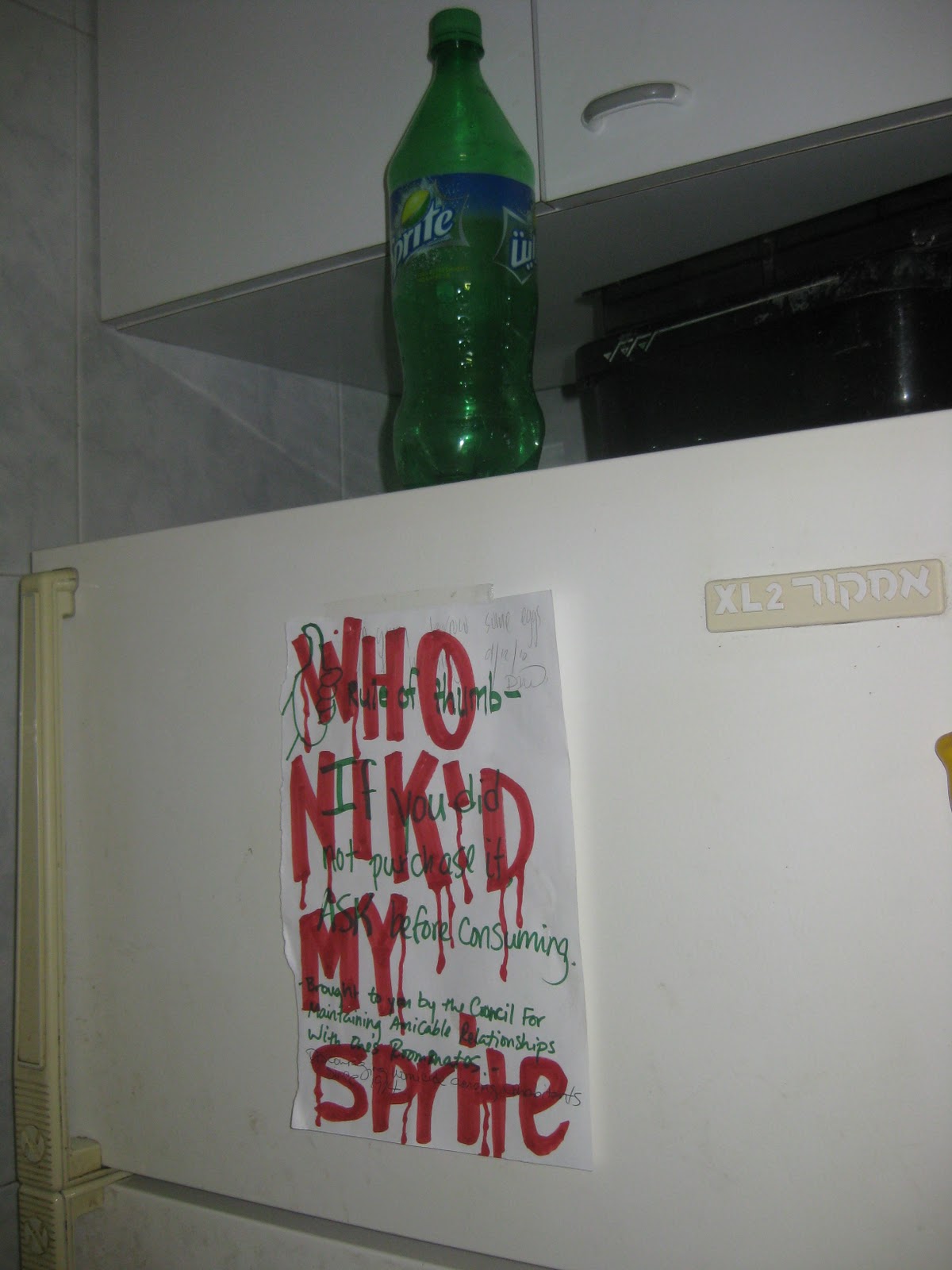
I woke up to find this one morning on my fridge.

Look at that tiger one of my first graders drew.  That is precious.

And that teddy bear?  You're getting a tooth ache, aren't you.

During a rousing game of Never Have I Ever in Jerusalem at the hostel.

Two of our PBS/TFP ladies, Helen and Sara.

Continuation of the hostel games in Jerusalem.

Yeah, that says "F. Z. R. FRiDAY'Z".  No, I have no idea what it's supposed to stand for.

Me with my first graders.